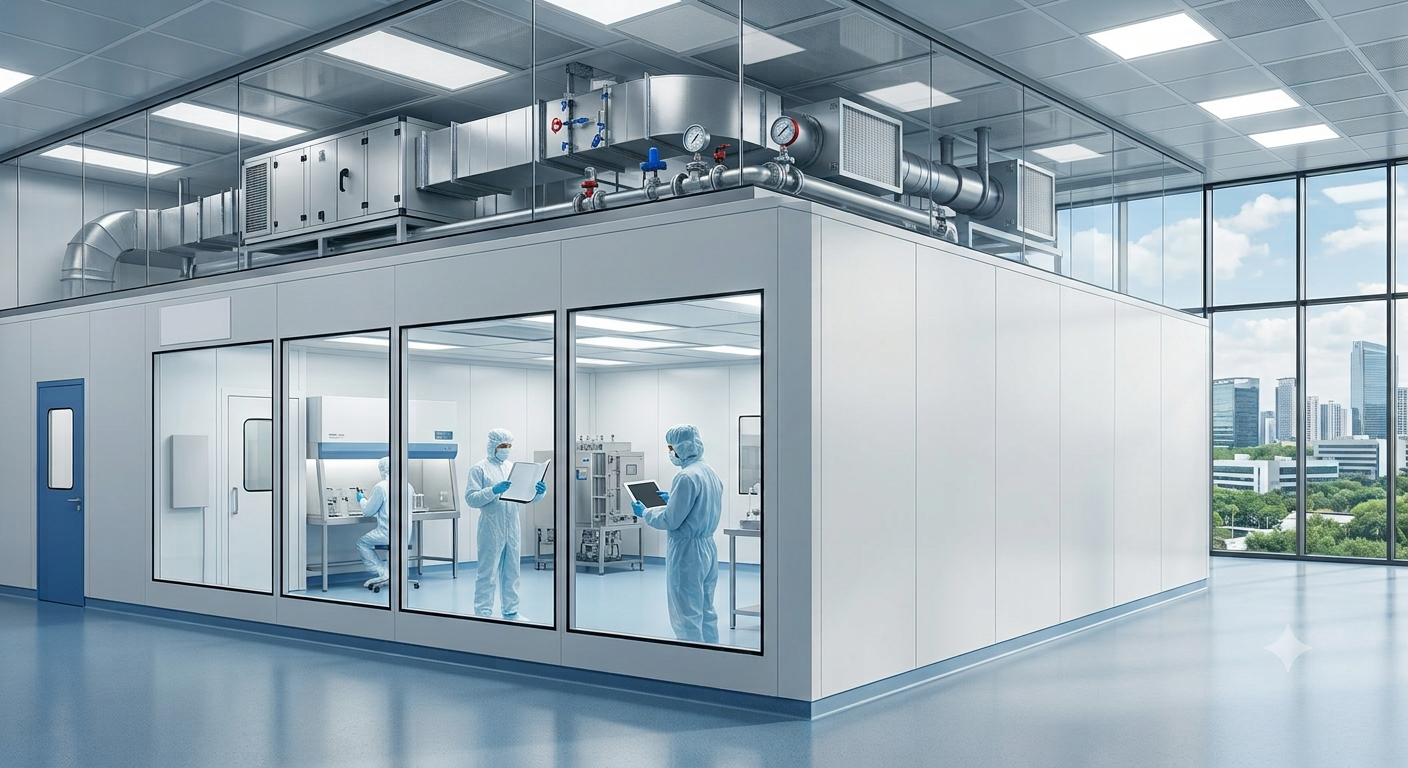
Cleanroom class decides how many airborne particles are allowed in your air. This guide explains ISO 5, ISO 7 and ISO 8 in simple terms, covering particle limits, airflow, GMP grade equivalents, applications and how to choose the right class.
A cleanroom's class tells you how many airborne particles are allowed in one cubic metre of air. Under ISO 14644-1, the lower the ISO number, the cleaner the room. ISO 5 is the cleanest of the three (used for aseptic filling and sterile work), ISO 7 is a controlled environment for support and gowning areas, and ISO 8 is the entry-level cleanroom for general controlled manufacturing and packing.
If you are planning a pharmaceutical plant, hospital operation theatre, medical device unit or electronics facility in India, choosing the right class is the first and most expensive decision you will make. Too low and you fail audits. Too high and you overspend on construction and running costs for years.
This guide explains ISO 5, ISO 7 and ISO 8 in plain language, with particle limits, airflow, pressure, applications and a simple way to choose.
What Is Cleanroom Classification?
Cleanroom classification is a standard way of measuring and labelling how clean the air in a controlled room is. The global standard is ISO 14644-1:2015, which sets nine classes, from ISO 1 (cleanest) to ISO 9 (least clean).
Classification is based on the maximum number of particles of a given size per cubic metre of air. The most commonly referenced size is 0.5 micrometres (µm), which is far smaller than a human hair (about 70 µm wide).
A few points people often miss:
- The ISO class is the result of design, filtration, airflow, pressure control and operating discipline working together. It is not a feature you can simply buy.
- Classification is checked in different states: as-built (empty), at-rest (equipment installed, no people) and in-operation (normal working conditions).
- A room must be re-certified periodically, typically every 6 to 12 months depending on class and industry rules.
ISO Cleanroom Classes at a Glance
Maximum permitted particles per cubic metre (ISO 14644-1:2015):
| ISO Class | ≥0.3 µm | ≥0.5 µm | ≥1.0 µm | ≥5.0 µm | Old Federal Std 209E equivalent |
|---|---|---|---|---|---|
| ISO 5 | 1,020 | 3,520 | 832 | 29 | Class 100 |
| ISO 7 | 102,000 | 352,000 | 83,200 | 2,930 | Class 10,000 |
| ISO 8 | 1,020,000 | 3,520,000 | 832,000 | 29,300 | Class 100,000 |
For comparison, ordinary office air typically contains millions of particles of 0.5 µm per cubic metre, which is roughly ISO 9.
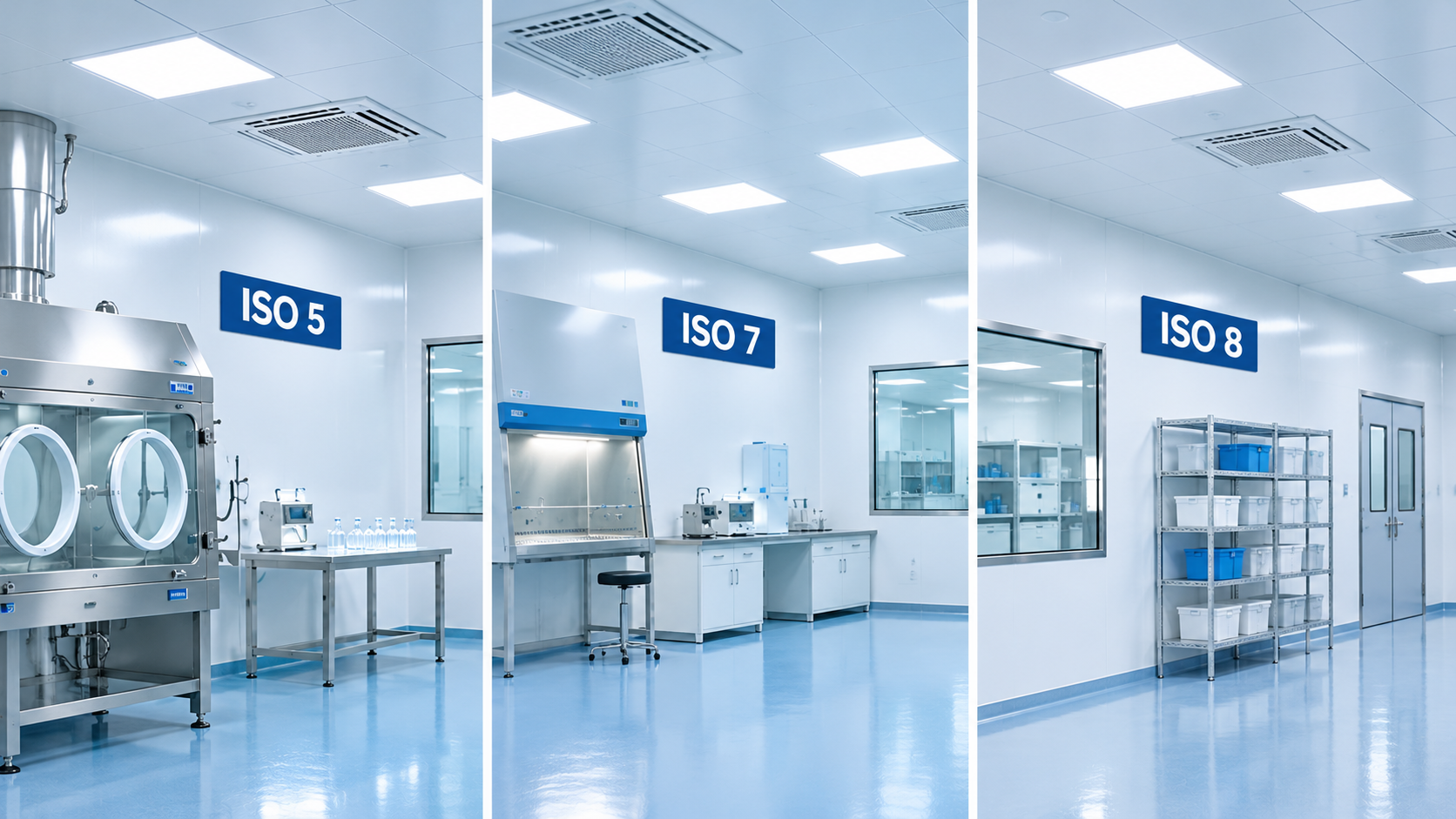
ISO 5 Cleanroom (Class 100)
What it means: No more than 3,520 particles of 0.5 µm per cubic metre of air. This is a very high level of cleanliness.
How it is achieved:
- Unidirectional (laminar) airflow, where filtered air moves in one direction at a controlled velocity, typically around 0.3 to 0.5 m/s
- HEPA or ULPA filters covering most of the ceiling or the critical zone
- Very high air change rates, commonly in the range of 240 to 480 per hour
- Strict gowning, material transfer through pass boxes, and minimal movement
Typical applications:
- Aseptic filling of injectables and sterile products
- Laminar air flow (LAF) workstations and biosafety work zones
- Sterility testing
- Semiconductor and precision optics critical processes
GMP link: ISO 5 corresponds to Grade A in EU GMP and WHO guidelines, the zone where critical sterile operations take place.
Key point: In most facilities, ISO 5 is not a whole room. It is a protected zone, such as a laminar flow unit or isolator, inside a larger ISO 7 or ISO 8 area. This approach saves significant cost.
ISO 7 Cleanroom (Class 10,000)
What it means: No more than 352,000 particles of 0.5 µm per cubic metre of air.
How it is achieved:
- Turbulent or mixed airflow with HEPA-filtered supply air through ceiling diffusers
- Air change rates commonly in the range of 40 to 60 per hour (design values vary with room size, heat load and process)
- Positive pressure relative to adjacent lower-class areas, typically 10 to 15 Pa between classes
- Smooth, cleanable surfaces, such as modular PUF panels, epoxy or PVC flooring and coved corners
Typical applications:
- Background environment surrounding ISO 5 zones
- Gowning and change rooms for sterile areas
- Medical device assembly and packaging
- Modular operation theatres for high-risk surgeries such as orthopaedic and transplant procedures
- Pharmaceutical compounding and formulation of sterile products
- Electronics and sensor assembly
GMP link: ISO 7 corresponds to Grade B (in operation) and Grade C (at rest) in EU GMP.
ISO 8 Cleanroom (Class 100,000)
What it means: No more than 3,520,000 particles of 0.5 µm per cubic metre of air.
How it is achieved:
- HEPA-filtered supply air with turbulent mixing
- Air change rates commonly in the range of 15 to 25 per hour
- Controlled pressure cascade, temperature and humidity
- Basic gowning discipline and controlled entry
Typical applications:
- Non-sterile pharmaceutical manufacturing, such as tablets, capsules, syrups and ointments
- Corridors and airlock areas in sterile facilities
- Primary packaging of medical devices and cosmetics
- Food and nutraceutical processing
- General electronics assembly
- Support areas around higher-class cleanrooms
GMP link: ISO 8 relates to Grade C (in operation) and Grade D (at rest).
Key point: ISO 8 is the most cost-effective entry class and is the right choice for many applications that do not need sterile conditions.
ISO 5 vs ISO 7 vs ISO 8: Side-by-Side Comparison
| Feature | ISO 5 | ISO 7 | ISO 8 |
|---|---|---|---|
| Cleanliness level | Very high | High | Moderate |
| Max particles ≥0.5 µm per m³ | 3,520 | 352,000 | 3,520,000 |
| Airflow pattern | Unidirectional | Turbulent/mixed | Turbulent/mixed |
| Typical air changes per hour* | 240–480 | 40–60 | 15–25 |
| Filtration | HEPA/ULPA | HEPA | HEPA |
| Typical use | Aseptic filling, LAF | Gowning, device assembly, OT | Non-sterile production, packaging |
| EU GMP grade link | A | B / C | C / D |
| Relative construction and running cost | Highest | Medium | Lowest |
*Indicative design ranges. Actual values depend on room volume, heat load, occupancy and the recovery time you need.
How to Choose the Right Cleanroom Class
Follow these five steps before you finalise a design.
1. Identify your regulatory requirement. For pharmaceuticals in India, check the revised Schedule M (GMP) under the Drugs and Cosmetics Rules, WHO TRS guidelines and, if you export, EU GMP Annex 1 and US FDA expectations. Medical devices follow ISO 13485 and ISO 14644 requirements.
2. Define your product risk. Sterile injectables need ISO 5 critical zones. Non-sterile oral solids typically need ISO 8 or lower classes.
3. Zone your facility. Put your highest-class area only where the process truly needs it, and step down the classes with airlocks and pressure cascades.
4. Plan for people and materials. Gowning rooms, pass boxes, material airlocks and personnel flow are where many cleanrooms fail in practice.
5. Budget for operating costs, not only construction. HVAC energy is the largest running cost. An ISO 7 room at 60 air changes per hour uses far less energy than an ISO 5 room at 300 or more.
What Goes Into Building a Compliant Cleanroom?
A certified cleanroom is a system of connected components:
- Modular cleanroom panels (PUF, PIR or rockwool-filled, with hygienic finishes)
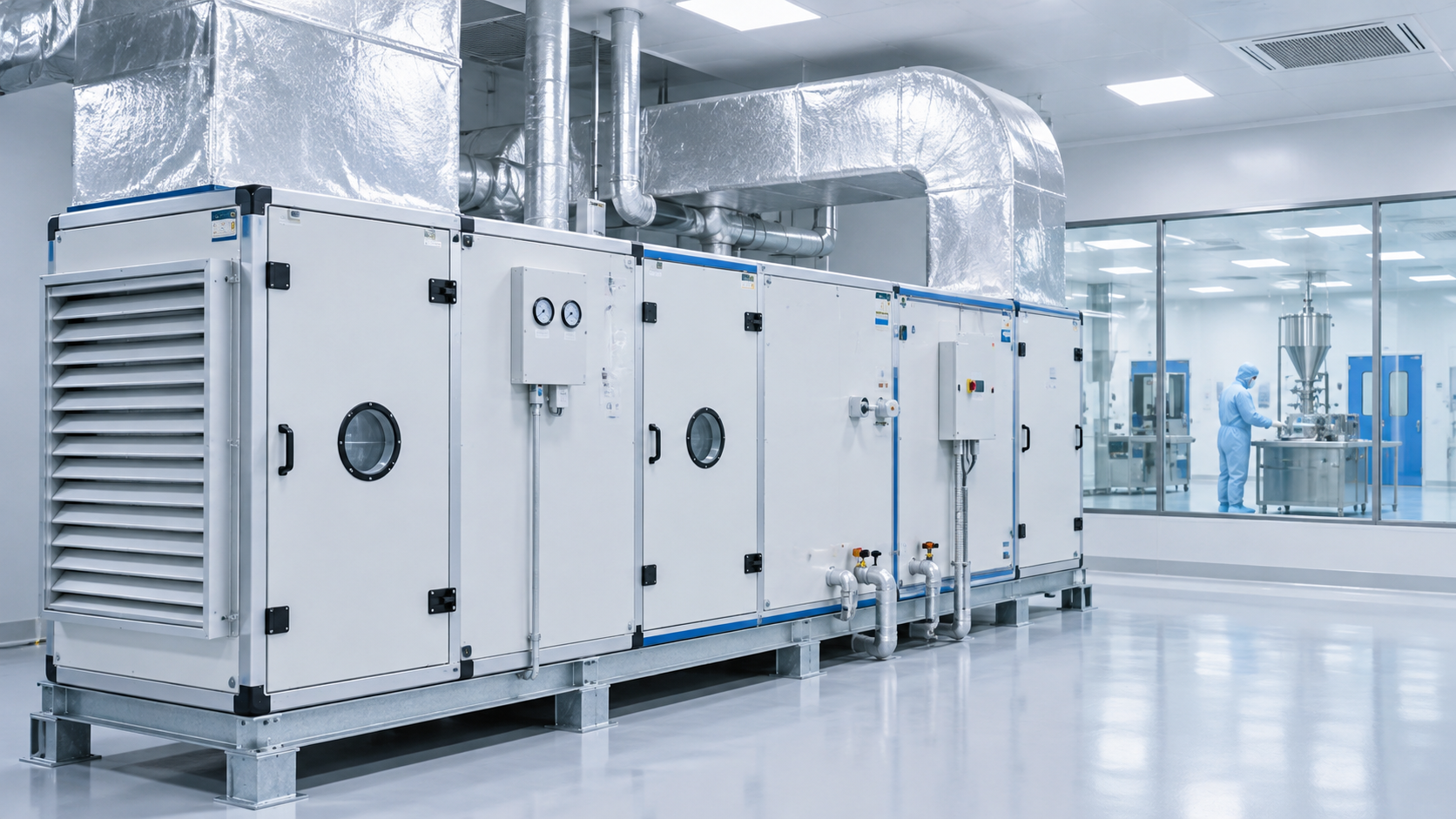
- HVAC system with air handling units, fresh air control, humidity control and a chiller or DX system
- HEPA filter boxes and terminal diffusers
- Pass boxes, air showers and interlocked doors
- Flooring, coving and sealed ceilings
- Pressure and temperature monitoring
- Validation and certification, including filter integrity testing, airflow visualisation, particle counts and recovery tests
Common Mistakes to Avoid
- Over-specifying the class. Building ISO 7 where ISO 8 is enough can add significant capital and energy cost.
- Ignoring the in-operation state. A room that passes when empty can fail once people and equipment are inside.
- Poor pressure cascade design. Without correct pressure differences between rooms, contamination moves from dirty areas into clean ones.
- Skipping maintenance. Filter loading, door seal damage and sensor drift quietly reduce performance over time.
- Treating validation as a one-time activity. Re-qualification is a recurring requirement.
Frequently Asked Questions
What is the difference between ISO 5, ISO 7 and ISO 8 cleanrooms?
The difference is the number of airborne particles allowed. ISO 5 allows up to 3,520 particles of 0.5 µm per cubic metre, ISO 7 allows 352,000 and ISO 8 allows 3,520,000. ISO 5 is the cleanest and costs the most to build and run.
Which cleanroom class is used for pharmaceutical manufacturing?
It depends on the product. Sterile injectables require ISO 5 for critical filling zones within an ISO 7 background. Non-sterile products such as tablets and syrups are commonly made in ISO 8 or lower-class controlled areas.
Is ISO 5 the same as Class 100?
Yes. ISO 5 is equivalent to Class 100 in the older Federal Standard 209E, which is still used informally in some industries.
What is the GMP grade equivalent of ISO 5, 7 and 8?
ISO 5 matches Grade A. ISO 7 matches Grade B and Grade C (at rest). ISO 8 matches Grade C (in operation) and Grade D (at rest).
How many air changes per hour does an ISO 7 cleanroom need?
Typical designs use about 40 to 60 air changes per hour, but the exact figure depends on room size, heat load, number of people and the required recovery time.
How often should a cleanroom be re-certified?
Most facilities test every 6 to 12 months, with higher-class areas such as ISO 5 usually tested more often. Always follow your applicable regulatory and internal quality requirements.
How much does it cost to build a cleanroom in India?
Cost depends on the class, area, HVAC load, finishes and validation scope. As a rough rule, cost per square foot rises sharply from ISO 8 to ISO 7 to ISO 5. A site-specific quotation based on your layout is the only reliable way to budget.
Planning a Cleanroom in Bangalore or Anywhere in India?
S.M.Enterprises is a Bengaluru manufacturer of cleanroom solutions, modular OTs and ICUs, HVAC systems, metal doors, lab furniture, electrical and BMS systems for pharmaceutical, healthcare, medical device and electronics industries. Our turnkey solutions cover design, manufacturing, installation, testing and validation and handover, built at our in-house facility.
Share your process, area and target class, and our team will help you choose the right ISO class and a layout that meets your compliance needs without overspending.
Request a Free Cleanroom Consultation | Call: 8296497411 / 8904450199 | Email: info@smentindia.com | WhatsApp: 8296497411
Sy no. 66/3, Bommanahalli, Indalavadi (post), Jigani (hobli), Anekal, Bangalore - 562106
Need this for your facility?
Get a detailed quote from our engineering team — typically within 24 hours.