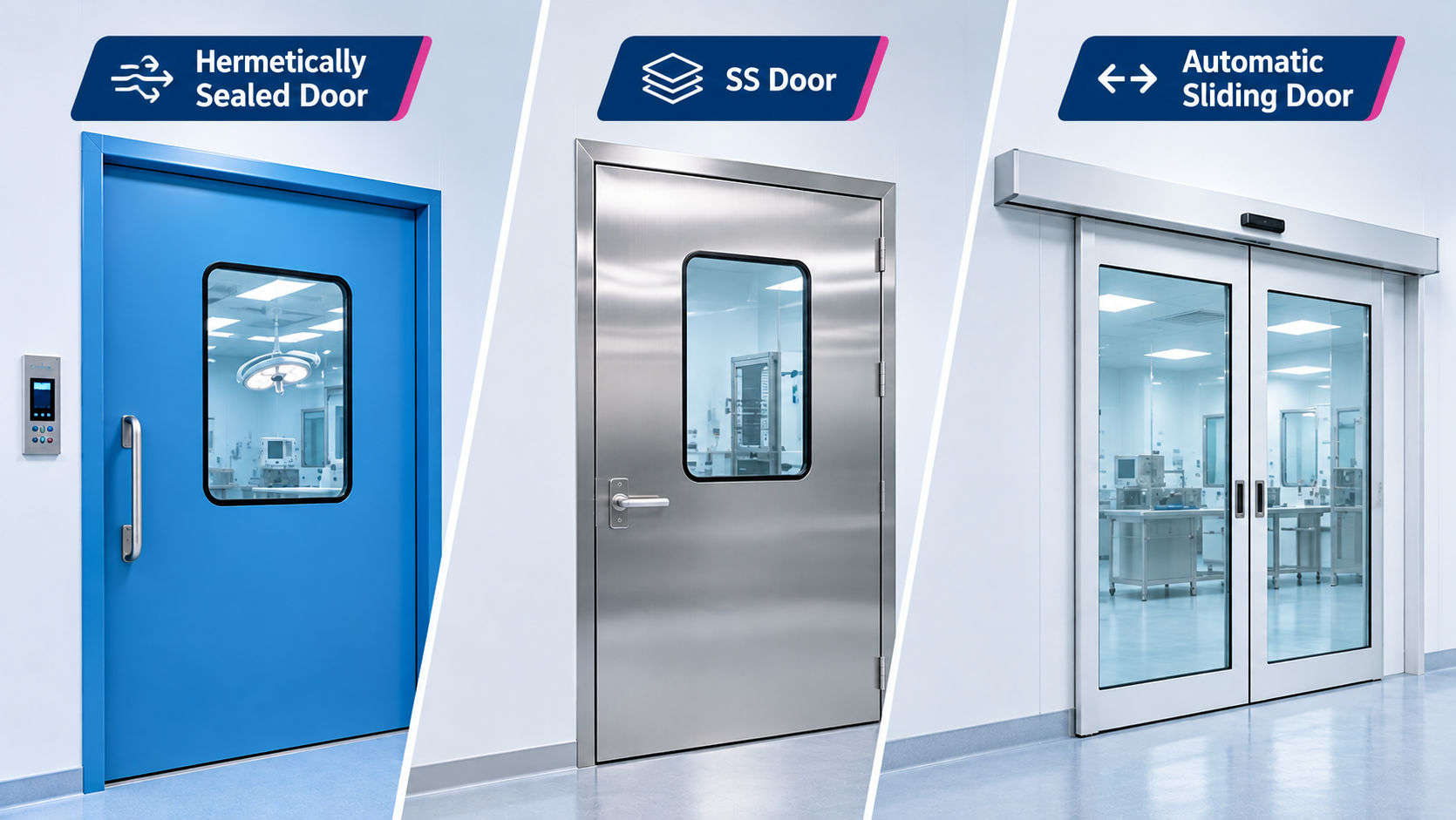
Not sure whether to choose hermetically sealed, stainless steel or automatic sliding doors? This guide compares all three and shows which door works best for operation theatres, ICUs, cleanrooms, labs and food plants, with a quick, practical room-by-room selection table.
The door is the most overlooked component in a controlled environment. Walls, ceilings and HVAC get the attention, but a wrong door can break your pressure cascade, let contaminants through, fail an audit or slow down staff every single day.
If you are planning an operation theatre, ICU, pharma cleanroom, laboratory or food facility, you will almost certainly face the same question: hermetically sealed doors, stainless steel (SS) doors or automatic sliding doors?
This guide explains what each door does, where it works best, and how to match the right door to the right room.
Quick Answer: Which Door Should You Choose?
- Choose hermetically sealed doors when the room needs an airtight seal to hold pressure and control contamination, such as operation theatres, ICUs and cleanrooms.
- Choose SS doors when the room needs corrosion resistance, easy washdown and a hygienic surface, such as pharma production areas, food processing and chemical or wet labs.
- Choose automatic sliding doors when you need hands-free access, fast opening and smooth traffic flow, such as hospital entrances, OT entries and high-traffic corridors.
These categories overlap. A door can be hermetic and automatic, or SS and hermetic. So the real decision is usually about what the room needs the door to do, not just the door's name.
What Are Hermetically Sealed Doors?
A hermetically sealed door is built to close airtight. It uses a flush, smooth profile with gaskets or seals around the frame so that air does not leak between rooms.
That matters because cleanrooms and operation theatres depend on controlled pressure differences between spaces. If air leaks around a door, the pressure cascade weakens, and unfiltered air or contaminants can move where they should not.
Key features
- Airtight sealing with gaskets or seals
- Flush, crevice-free surfaces that are easy to wipe and disinfect
- Available in swing and sliding formats, manual or automatic
- Often fitted with vision panels so staff can see in without opening the door
Best for: operation theatres and ICUs, isolation rooms, cleanrooms and any space where pressure and air quality must be maintained.
Limitations: the door must be correctly installed and matched with the wall panels and frame. A hermetic door in a poorly sealed room does not solve the problem.
What Are Stainless Steel (SS) Doors?
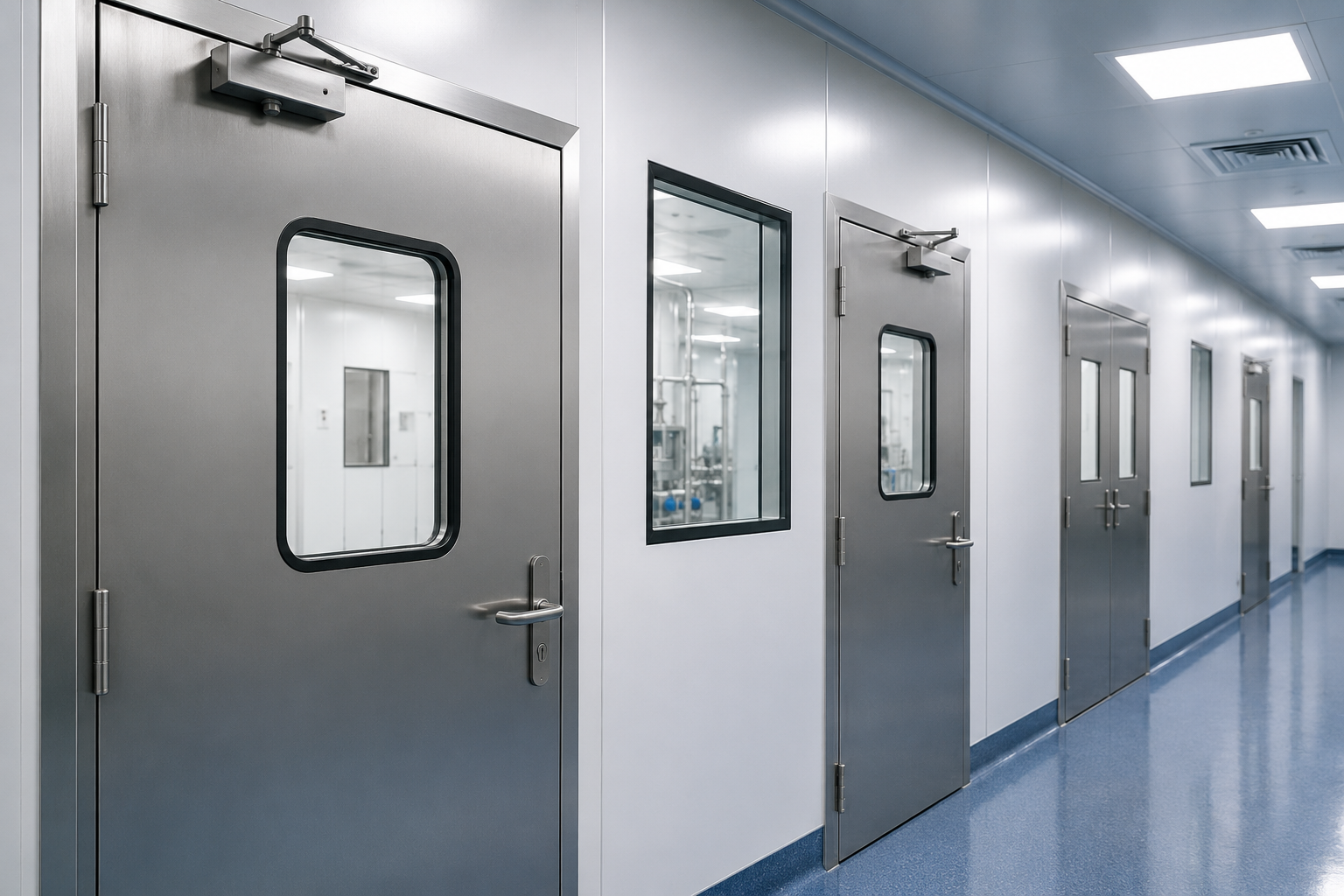
SS doors are defined by their material. Stainless steel resists rust, withstands frequent cleaning with disinfectants and stays smooth and hygienic for years.
The grade matters. SS304 suits most general hygienic applications, while SS316 offers stronger resistance in harsher chemical or saline environments.
Key features
- Excellent corrosion resistance
- Tolerates frequent washdown and strong cleaning agents
- Durable under heavy daily use
- Can be made flush and gasketed for cleanroom use
Best for: pharmaceutical production areas, food and beverage plants, laboratories, wash areas and any space with moisture or chemical exposure.
Limitations: an SS door is not automatically airtight. If you need pressure control, specify a flush, gasketed SS door built for cleanroom use rather than a standard SS door.
What Are Automatic Sliding Doors?
Automatic sliding doors open and close using a motor and sensor, so no one has to touch them. They slide along a track instead of swinging, which saves floor space and keeps movement quick and smooth.
In hospitals, this is a real infection-control advantage. When staff are carrying instruments or wearing gloves, hands-free entry reduces contact points and keeps workflow moving.
Key features
- Touch-free, sensor-based operation
- Fast opening that suits high-traffic areas
- No swing radius, so they work in tight spaces
- Hospital-grade versions can be built with hermetic sealing
Best for: operation theatre entrances, ICU and hospital corridors, patient and trolley movement areas, and busy clean-to-clean transitions.
Limitations: standard commercial sliding doors are not airtight. For OTs and cleanrooms, specify a hermetic automatic sliding door, not a general-purpose one.
Hermetic vs SS vs Automatic Sliding Doors: Side-by-Side Comparison
| Feature | Hermetically Sealed Door | SS Door | Automatic Sliding Door |
|---|---|---|---|
| Main strength | Airtight sealing | Corrosion resistance and hygiene | Hands-free, fast access |
| Controls pressure | Yes | Only if gasketed and flush | Only if hermetic type |
| Washdown tolerance | Good, depends on skin material | Excellent | Good, depends on build |
| Hands-free use | Optional (automatic version) | No, unless motorised | Yes |
| Space needed | Swing or slide | Usually swing | Slide, saves floor space |
| Best rooms | OT, ICU, cleanrooms | Pharma, food, labs | OT entry, corridors, ICU |
Which Door for Which Room? Room-by-Room Guide
| Room | Recommended Door | Why |
|---|---|---|
| Operation theatre | Hermetic automatic sliding door | Holds pressure, hands-free, easy to disinfect |
| ICU and isolation rooms | Hermetic door (sliding or swing) | Controls airflow and cross-contamination |
| Pharma cleanroom (ISO 7/8, Grade C/D) | Flush, gasketed SS or hermetic door | Hygienic, pressure-friendly, durable |
| Aseptic and sterile areas | SS flush door with interlock | Strict contamination and pressure control |
| Airlocks and change rooms | Interlocked hermetic or SS doors | Only one door opens at a time to protect the cascade |
| Food and beverage processing | SS (304 or 316) door | Withstands washdown and moisture |
| Chemical or wet laboratory | SS door | Resists corrosion from chemicals and cleaning agents |
| Hospital corridors and entrances | Automatic sliding door | High traffic, touch-free access |
| Material pass-through | Hermetic or SS door with interlock | Keeps clean and non-clean zones separate |
Use this as a starting point. Final selection depends on your cleanliness classification, pressure design, applicable standards (such as ISO 14644, GMP and NABH) and how often the door is used.
5 Factors to Check Before You Decide
1. Cleanliness class and pressure design. Rooms that depend on pressure differentials need airtight doors. Check your design before you pick a door.
2. Traffic and usage. A door used hundreds of times a day needs a robust motor, track and sensors. A rarely used door can be simpler.
3. Cleaning and chemical exposure. Frequent disinfectants or washdown point to SS. Choose the grade based on the chemicals involved.
4. Compliance requirements. Pharma, hospital and food facilities each follow different standards. Confirm what your auditors expect before finalising the door, and plan for testing and validation once the room is installed.
5. Integration with walls, HVAC and interlocks. The door must match the wall panels, frame and airflow design, and airlocks often need interlock systems. Doors work best when designed together with the room, not added at the end.
Common Mistakes to Avoid
- Using a standard commercial sliding door in an OT. It looks modern but may not seal.
- Assuming SS means airtight. SS describes the material, not the sealing performance.
- Ignoring interlocks in airlocks. Two doors open at once can collapse your pressure cascade.
- Buying doors separately from the room design. Mismatched frames and panels cause leaks and delays.
- Choosing on price alone. A cheaper door that fails validation costs far more to fix later.
Why Buy Cleanroom Doors From a Manufacturer?
When the same company designs the room and manufactures the door, the frame, panel and seal are built to work together. That cuts site rework, speeds up installation and makes validation smoother.
S.M.Enterprises is a Bengaluru-based manufacturer with an in-house 1.5-acre facility and over 6,000 projects completed since 2009. Our metal doors range covers fire-rated, SS, hermetically sealed and automatic sliding doors for hospitals, pharma plants, laboratories and industry.
These doors are built to integrate with our clean room solutions and our modular OT and ICU systems, so the door, wall and HVAC design work as one system. Once installed, our testing and validation services help confirm the room performs as designed.
Frequently Asked Questions
What is the difference between hermetically sealed doors and SS doors?
A hermetically sealed door is defined by its airtight sealing, while an SS door is defined by its stainless steel material. A door can be both: an SS door built flush with gaskets can be hermetic. The right choice depends on whether the room needs pressure control, corrosion resistance or both.
Which door is best for an operation theatre?
Most modern operation theatres use hermetically sealed doors, commonly in an automatic sliding format. They hold room pressure, support touch-free entry and have smooth surfaces that are easy to disinfect.
Are automatic sliding doors airtight?
Not all of them. Standard commercial sliding doors are designed for convenience, not sealing. For OTs, ICUs and cleanrooms, you need a hermetic automatic sliding door built specifically for controlled environments.
Which door is best for a pharmaceutical cleanroom?
Flush, gasketed SS doors or hermetic doors are common in pharma cleanrooms because they are hygienic, durable and compatible with pressure control. Airlocks usually add interlocks so only one door opens at a time. The exact choice depends on your cleanliness grade and GMP requirements.
Should I use SS304 or SS316 for cleanroom doors?
SS304 works for most general hygienic applications. SS316 is better when the room faces harsher chemicals, chlorides or saline exposure. Your process and cleaning agents should decide the grade.
Can one room use more than one type of door?
Yes, and it is common. A hospital may use automatic sliding doors at the main entrance, hermetic doors in the OT and SS doors in the sterile processing area. Each door should match what that specific space needs.
Final Thoughts
There is no single best door. Hermetic doors protect air quality, SS doors protect against corrosion and wear, and automatic sliding doors protect workflow and reduce contact. The right choice is the one that fits the room's purpose, standards and daily use.
Plan Your Cleanroom or OT Doors With SME
Not sure which door suits your room? Share your room type, size and compliance needs, and talk to the experts at S.M.Enterprises.
- Call: 8296497411 / 8904450199
- Email: info@smentindia.com
- WhatsApp: Chat with us
- Contact page: Request a free quote
Related reading and services: Modular OT & ICU | HVAC Systems | Clean Room Solutions | Turnkey Solutions
Need this for your facility?
Get a detailed quote from our engineering team — typically within 24 hours.