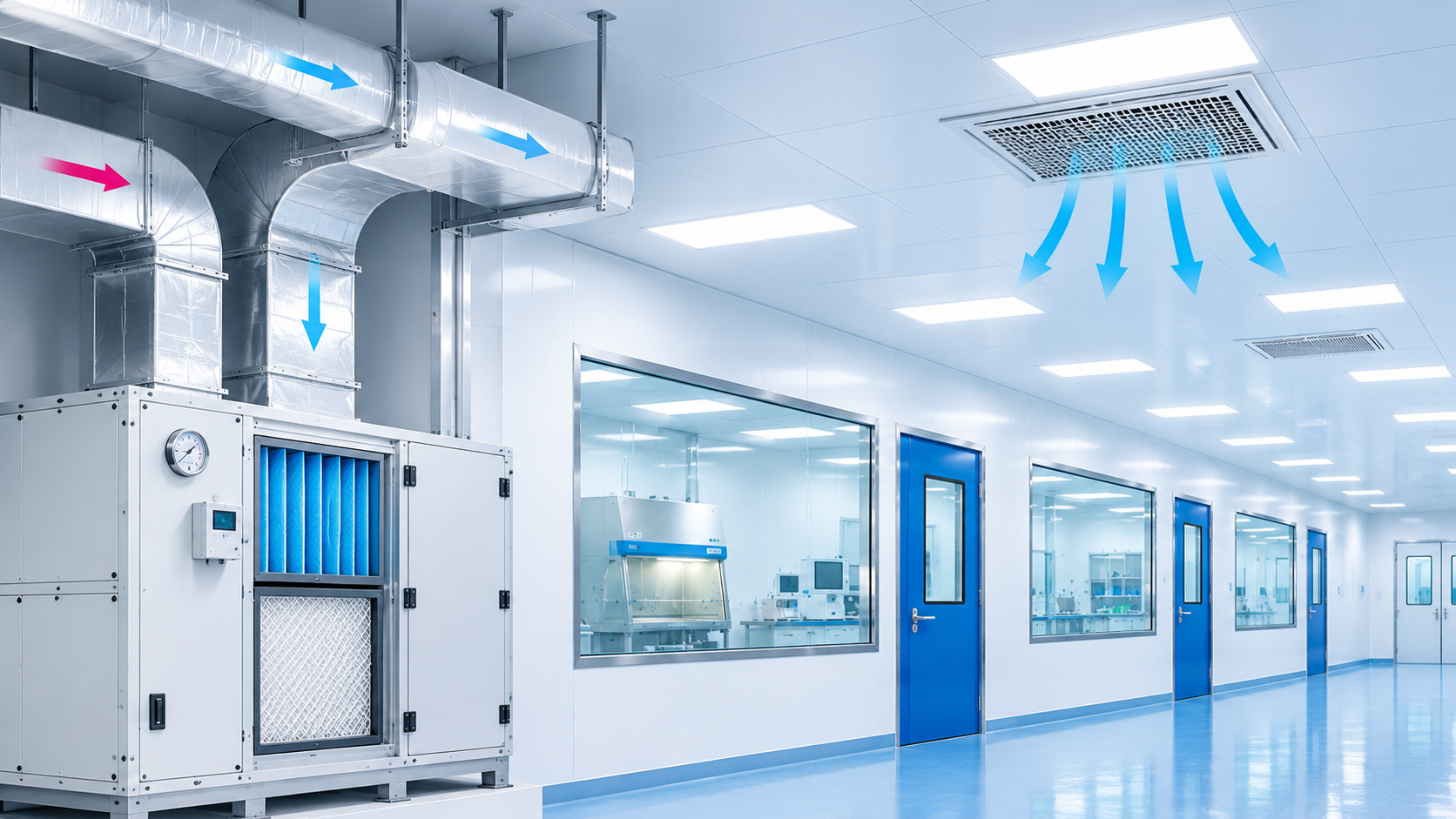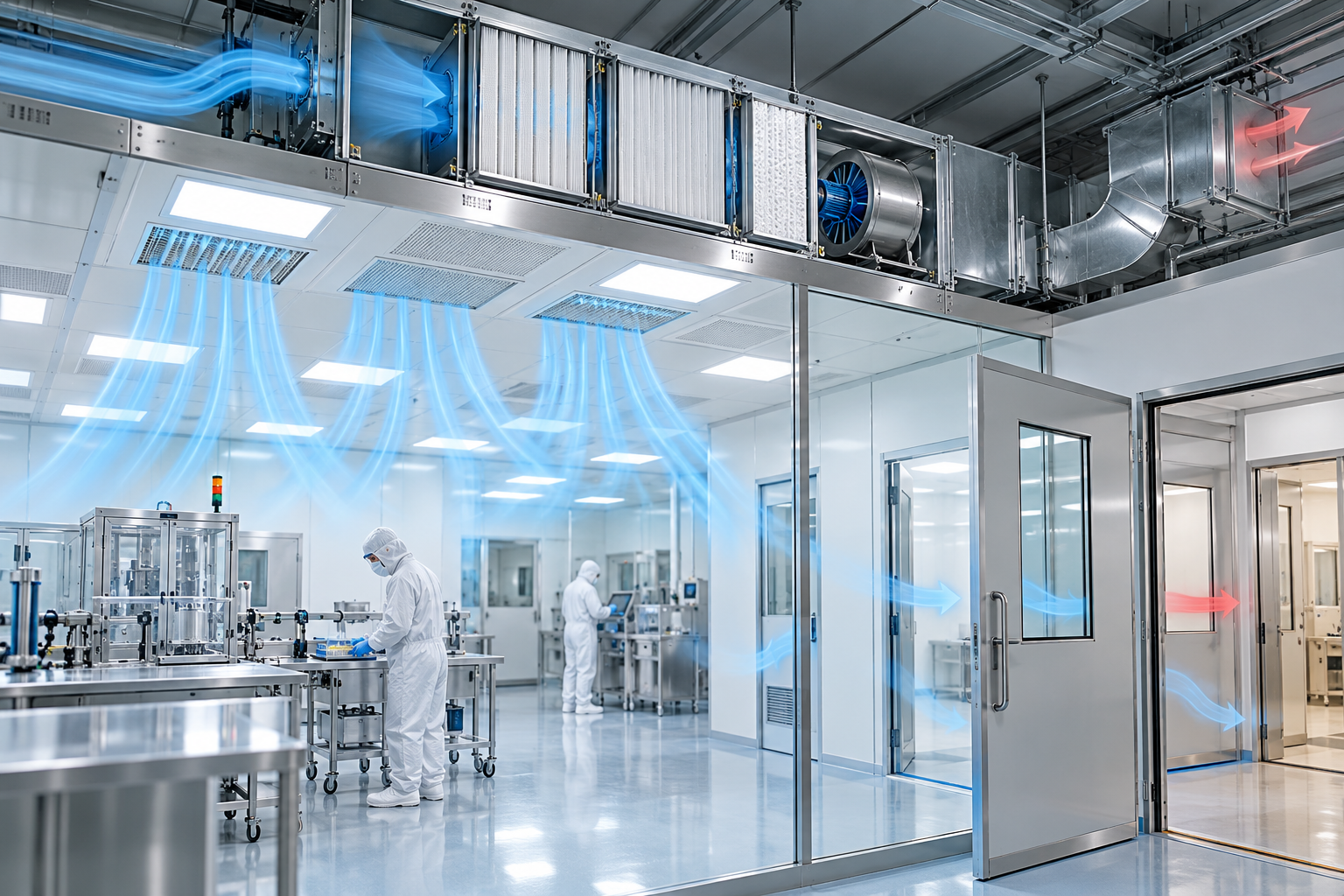
Choosing the right air handling unit decides whether a pharma cleanroom stays compliant. This guide explains once-through, recirculatory, multi-filtration, combo filtration, exhaust, ventilation units and FFUs, where each fits, and how to select the best option for your pharma facility.
The Air Handling Unit (AHU) is the heart of every pharmaceutical cleanroom. It controls the things that decide whether a batch is safe or contaminated: particle count, temperature, humidity, airflow and room pressure. A wrongly selected AHU can lead to failed qualification, product contamination, cross-contamination between products and regulatory observations.
There is no single AHU that suits every pharma area. A tablet compression room, a sterile filling line, a potent compound suite and a warehouse each need a different air strategy. In this guide, we explain the main types of AHU for pharma cleanrooms, how each one works, where it is used, and how to choose between them.
What Is an AHU in a Pharma Cleanroom?
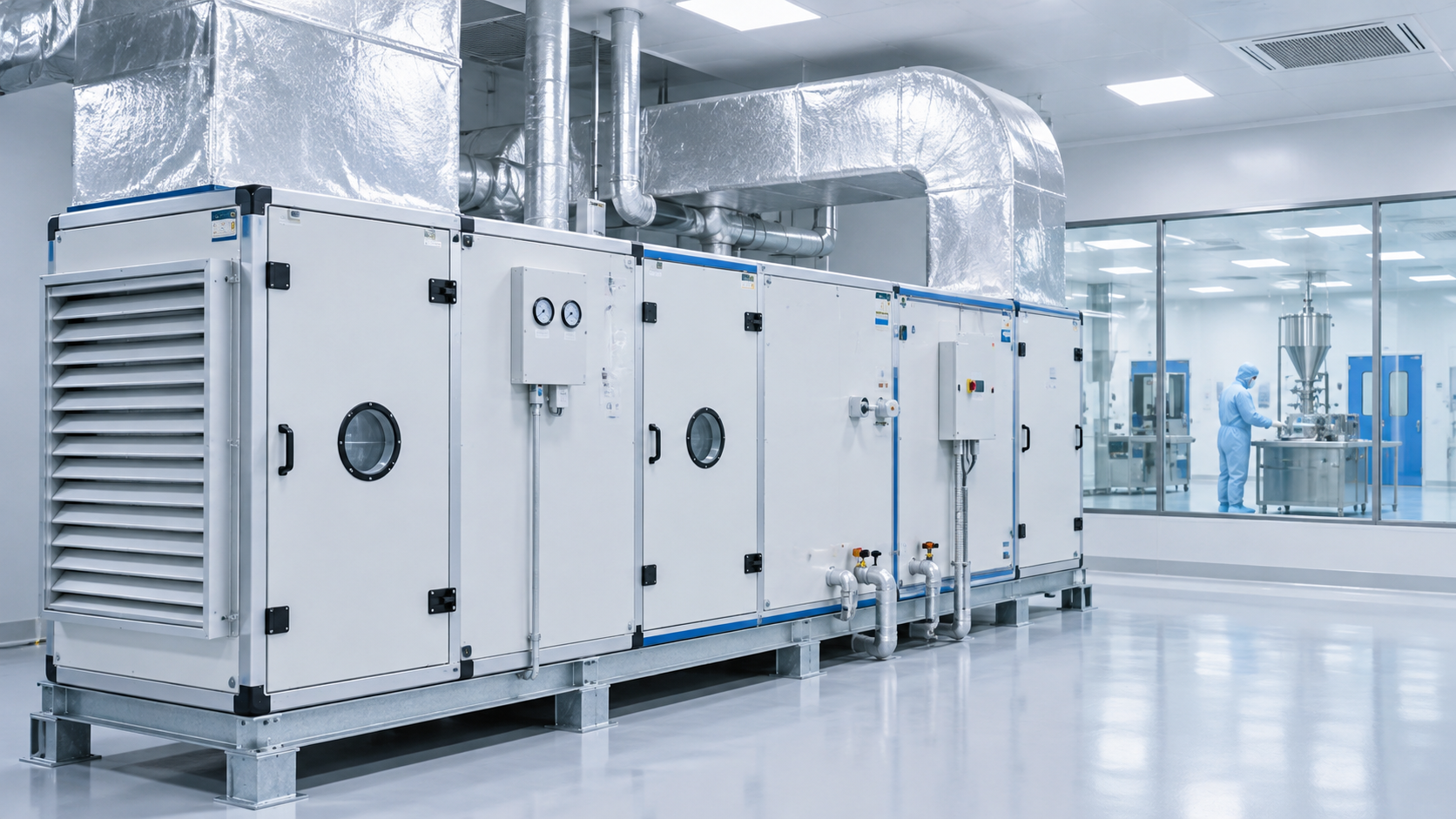
An AHU is a factory-built air treatment system that takes in air (fresh air, return air or a mix of both), cleans it, conditions it and delivers it to the cleanroom at the required volume and pressure.
A typical pharma AHU contains:
- Fresh air and return air dampers
- Pre-filter and fine filter sections
- Cooling coil (chilled water or DX) and heating or reheat coil
- Humidifier or dehumidification arrangement
- Supply fan with a VFD (variable frequency drive)
- Terminal HEPA filters, usually installed in the ceiling or at the room supply
- Double-skin insulated panels, a sloped drain pan and pressure gauges across each filter stage
In practice, the AHU works together with HEPA housings, return air risers, exhaust systems and a pressure cascade. Good AHU selection must follow the room classification (ISO 14644-1 classes or EU GMP Grades A to D), the product type and your GMP requirements, such as Schedule M in India, WHO GMP and EU GMP Annex 1.
Why AHU Type Selection Matters in Pharma
- Contamination control: The air supply is the main carrier of particles and microbes.
- Cross-contamination prevention: Products like penicillins, cephalosporins, hormones and cytotoxics need strict air segregation.
- Pressure cascade: Rooms of different classes must maintain a differential pressure, typically 10 to 15 Pa between adjacent classified areas.
- Energy cost: HVAC can be a very large share of a pharma plant's energy use, so the wrong type directly increases operating cost.
- Regulatory compliance: Your design must be qualified (DQ, IQ, OQ, PQ) and defensible during audits.
Types of AHU for Pharma Cleanrooms
1. Once-Through AHU (100% Fresh Air AHU)
A once-through AHU, also called a 100% fresh air AHU or full fresh air system, draws all its supply air from outside, treats it, delivers it to the room and then discharges all of it through exhaust. No air is returned to the AHU.
Where it is used:
- Areas handling solvents, flammable vapours or toxic fumes
- Potent and hazardous compound areas
- Penicillin, cephalosporin, hormone and cytotoxic manufacturing
- Dust-heavy zones and some microbiology or animal house areas
Advantages:
- Zero recirculation, so there is the lowest risk of cross-contamination
- Constantly renewed air gives better dilution of airborne contaminants
Limitations:
- Highest energy consumption, because all outside air must be cooled, dehumidified and heated
- Larger coils and chillers are needed
Tip: Energy recovery options such as run-around coil loops or heat pipes can reduce the load. Where containment is critical, avoid recovery devices that can transfer air between exhaust and supply streams.
2. Recirculatory AHU
This is the most common AHU in pharma plants. A recirculatory AHU mixes a controlled portion of fresh air with return air from the room. The mixed air is filtered, conditioned and supplied back to the cleanroom.
Where it is used:
- Oral solid dosage (OSD) areas with proper dust control
- Liquid and ointment areas where no hazardous vapours exist
- Packing halls, sterile area support zones, labs and QC
- Areas using the same product in a closed circuit
Advantages:
- Much lower energy use, since conditioned return air is reused
- High air change rates can be achieved at a lower running cost
- Easier control of temperature and humidity
Limitations:
- Not suitable where there is a risk of cross-contamination through return air
- Needs good return air filtration and a correct fresh-air ratio to maintain pressure and ventilation
3. Multi-Filtration AHU
A multi-filtration AHU uses several stages of filtration in sequence, so each stage protects the next and extends the life of the expensive final filter.
A typical filtration train is:
| Stage | Filter | Purpose |
|---|---|---|
| 1 | Pre-filter (coarse, G4 or ISO Coarse grade) | Removes large dust and insects |
| 2 | Fine filter (F8 or F9, or ePM1 grade) | Removes fine particulates |
| 3 | Terminal HEPA filter (H13 or H14) at room supply | Removes sub-micron particles and microorganisms |
| 4 (critical areas) | ULPA or additional HEPA | For high-grade aseptic zones |
Where it is used: Sterile manufacturing, filling and aseptic areas, biologics, injectable and ophthalmic facilities, and any ISO 5 to ISO 7 environment.
Key benefit: Stable cleanroom performance with a longer HEPA filter life. HEPA H14 filters are rated at 99.995% efficiency at the most penetrating particle size under EN 1822.
4. Combo Filtration AHU
A combo (combination) filtration AHU combines different types of filtration in one air handling system. Beyond the standard particulate filters, it may add gas-phase filtration such as activated carbon, or combine pre-filter, fine filter and HEPA sections in a compact single unit.
Where it is used:
- Facilities with odour, solvent vapour or chemical fumes in the supply or return air
- Sites in polluted urban areas where the outside air has gaseous contaminants
- Plants that need a compact AHU with all filter stages in one footprint
Key benefit: Controls both particles and gaseous contaminants without needing multiple separate units.
5. Exhaust AHU (Exhaust Air Unit)
An exhaust unit removes air from process areas to keep the right pressure balance and to carry away dust, vapours and fumes at the source.
Where it is used:
- Granulation, compression and coating dust-generating areas
- Dispensing and sampling booths
- Washing areas, solvent rooms and potent compound handling
Design points:
- HEPA filtration on exhaust (often bag-in/bag-out arrangement) for potent or hazardous materials
- Interlock with the supply AHU, so that pressure cascade is never lost if one unit fails
- Correct duct velocity to avoid dust settling
6. Ventilation Unit (Fresh Air or Make-Up Air Unit)
A ventilation unit supplies treated fresh air to the building. It filters, cools or dehumidifies, and sometimes heats the outside air before it is delivered to the cleanroom AHUs or to general areas.
Where it is used:
- Pre-conditioning of fresh air for recirculatory AHUs, which reduces their load and controls humidity in the monsoon season
- Non-critical areas such as corridors, change rooms, utility and warehouse spaces
- Maintaining positive building pressure and meeting minimum fresh air needs for occupants
Key benefit: Separating the fresh air treatment from the recirculation system gives better humidity control and improved energy efficiency.
7. FFU (Fan Filter Unit)
An FFU is a self-contained module with a fan and a HEPA or ULPA filter. It sits in the ceiling grid and pushes clean air down into the cleanroom. Strictly speaking, an FFU is a terminal air-cleaning unit, but it is widely used with or in place of ducted AHU systems.
Where it is used:
- Modular cleanrooms, retrofit projects and quick expansions
- Local ISO 5 zones inside a larger ISO 7 or ISO 8 room
- Laminar airflow stations, sampling and weighing areas
- Labs, packing and non-sterile pharma areas
Advantages:
- Easy installation with no heavy ductwork, so a faster build
- Flexible, as units can be added or relocated
- Lower ceiling space requirement
Limitations:
- Many fans mean more points to maintain and monitor
- Humidity and temperature control still needs a separate system, for example a fresh air unit or small AHU
Comparison at a Glance
| Type | Air source | Best for | Energy use | Cross-contamination risk |
|---|---|---|---|---|
| Once-through AHU | 100% fresh air | Solvents, potent drugs, penicillin | High | Lowest |
| Recirculatory AHU | Fresh plus return air | OSD, general pharma areas | Low to moderate | Moderate (managed by filtration) |
| Multi-filtration AHU | Either | Sterile and aseptic areas | Moderate | Low |
| Combo filtration AHU | Either | Gaseous and particulate control | Moderate | Low |
| Exhaust unit | Room air out | Dust and fume extraction | Moderate | Protects the surroundings |
| Ventilation unit | Fresh air | Pre-conditioning, support areas | Moderate | Low |
| FFU | Room air (recirculated) | Modular rooms, local ISO 5 | Low | Depends on room design |
How to Choose the Right AHU for Your Pharma Cleanroom
Use these questions during design:
- What is the product? Hazardous, potent or sensitising products usually need once-through air and HEPA-filtered exhaust.
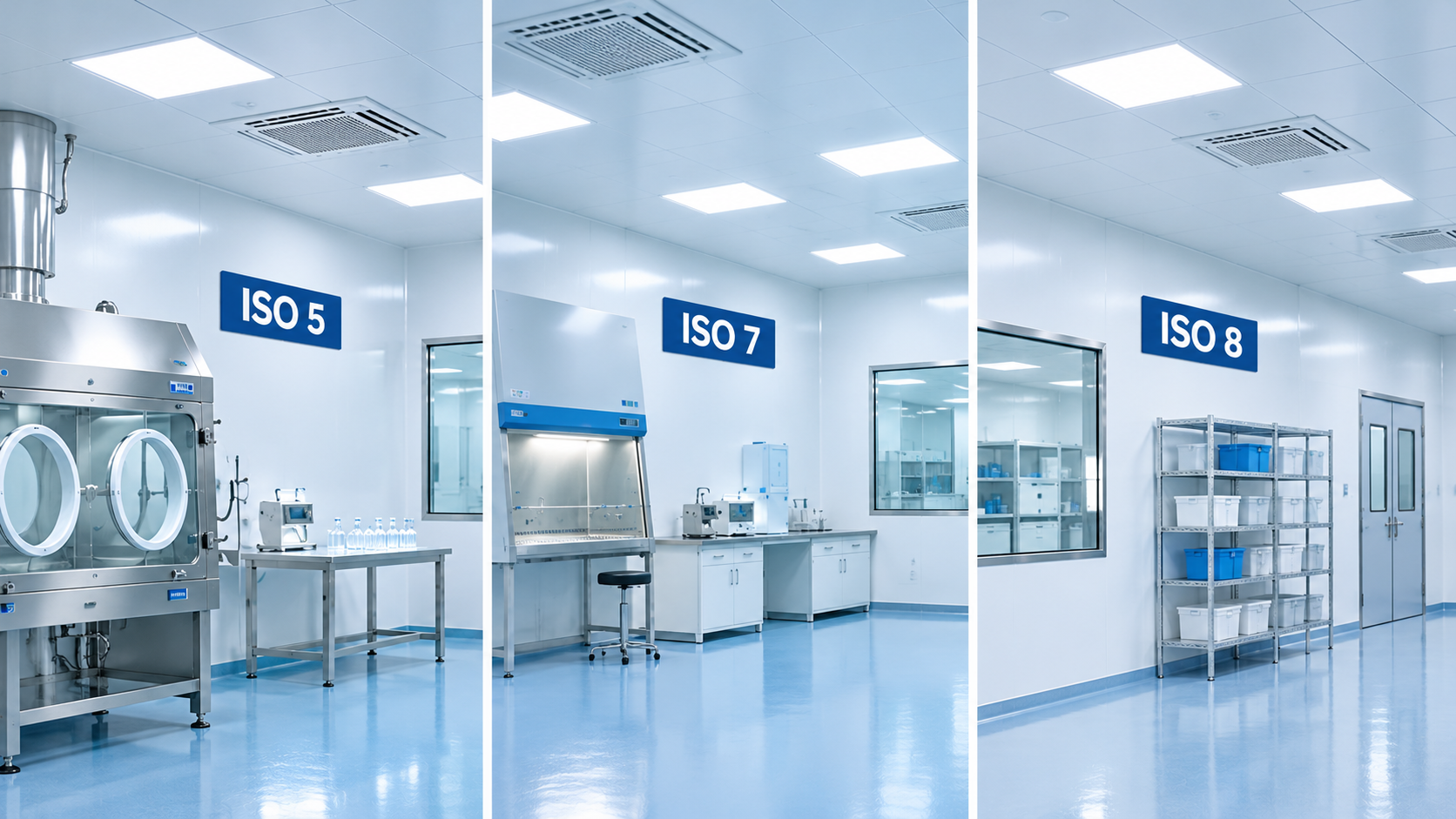
- What is the room classification? ISO 8 (Grade D), ISO 7 (Grade C), ISO 5 background (Grade B) and ISO 5 (Grade A) need progressively higher air change rates and filtration.
- Are solvents or vapours present? If yes, consider once-through air and explosion-safe design.
- What are the temperature and humidity limits? Typical pharma targets are around 20 to 25 °C and 45 to 55% RH, but your process and product stability data decide this.
- What is your energy budget? Recirculation, VFDs, heat recovery (where safe) and a separate fresh air unit can reduce running costs.
- How flexible must the facility be? FFUs suit modular, expandable layouts.
- What does your regulator expect? Check Schedule M, WHO GMP, EU GMP Annex 1 and ISO 14644 for your market.
Key Design Features of a Good Pharma AHU
- Double-skin, thermally broken panels with a smooth, cleanable internal finish
- Stainless steel or properly coated drain pan with a correct slope and trap
- Filter pressure gauges or sensors on every stage
- Sealed HEPA housings with a scan-test or DOP/PAO test port
- VFD-controlled fans for stable airflow as filters load
- Interlocks between supply, return and exhaust
- Easy access for cleaning, validation and maintenance
Common Mistakes to Avoid
- Using a recirculatory system where cross-contamination is a real risk
- Placing HEPA filters only at the AHU and not at the room terminal
- Ignoring the monsoon humidity load on the fresh air
- Skipping a pressure cascade study before finalising the layout
- Choosing the cheapest unit without considering lifecycle and filter replacement cost
FAQs
What is the difference between once-through and recirculatory AHU? A once-through AHU treats 100% fresh air and exhausts all of it, so no air is reused. A recirculatory AHU mixes fresh air with return air to save energy. Once-through is used where cross-contamination risk is high, and recirculatory in general pharma areas.
Which AHU is used for sterile areas? Sterile and aseptic areas generally use multi-filtration AHUs with terminal HEPA filters. Critical zones may use unidirectional airflow with HEPA or ULPA filtration to reach Grade A or ISO 5.
What filters are used in a pharma AHU? A typical train has a pre-filter, a fine filter (F8 or F9) and a terminal HEPA filter (H13 or H14). Some systems add activated carbon for gaseous contaminants.
Is an FFU the same as an AHU? No. An AHU is a central unit that conditions and cleans air and delivers it through ducts. An FFU is a small ceiling module with a fan and a HEPA filter that cleans room air locally. They are often used together.
Why is an exhaust unit needed in a pharma cleanroom? Exhaust units remove dust, fumes and vapours at the source, protect operators and maintain the pressure cascade between rooms.
How many air changes per hour does a pharma cleanroom need? It depends on the class and the process. As indicative ranges, ISO 8 areas often run at around 20 or more ACPH, ISO 7 at around 30 to 60 and ISO 6 or ISO 5 areas at much higher rates. Final values come from your design, heat load and qualification data.
Conclusion
The right AHU for a pharma cleanroom depends on your product, room class, contamination risk and operating budget. Once-through units protect against cross-contamination, recirculatory units save energy, multi-filtration and combo filtration units deliver the required air cleanliness, exhaust and ventilation units keep the building balanced, and FFUs add flexibility. Often, a well-designed plant uses a mix of all of them.
Plan Your Pharma Cleanroom With SME
Planning a new pharma cleanroom or upgrading an existing one? Talk to the experts at S.M.Enterprises.
- Call: 8296497411 / 8904450199
- Email: info@smentindia.com
- WhatsApp: Chat with us
- Contact page: Request a free quote
Related reading and services: Modular OT & ICU | HVAC Systems | Clean Room Solutions | Turnkey Solutions
Need this for your facility?
Get a detailed quote from our engineering team — typically within 24 hours.