Cleanroom pressure differentials and particle counts drift when airflow balance changes, often because of loaded filters, damper or fan drift, leaking doors and panels, or uncalibrated sensors. This guide explains the common causes, a step-by-step troubleshooting method and the checks that keep your cleanroom within ISO 14644 and GMP limits.
Cleanroom pressure differentials and particle counts drift when airflow balance changes. The usual causes are loaded filters, door and leakage problems, damper or fan-speed drift, sensor errors and changes in how people and materials move through the room. Check filter pressure drop, supply and return airflow, room leakage and sensor calibration first, in that order.
Key takeaways
- Most drift comes from a change in airflow balance, not from one failed component.
- Rooms in a classified suite typically need a 10-15 Pa pressure cascade between adjacent areas. A few pascals of drift can break that cascade.
- Particle counts are measured against ISO 14644-1 limits. The room’s classification (ISO 5, 7 or 8) depends on both HVAC performance and operating behaviour.
- Fix the cause, not the alarm. Resetting a setpoint without finding the root cause usually brings the problem back.
Why pressure differentials matter
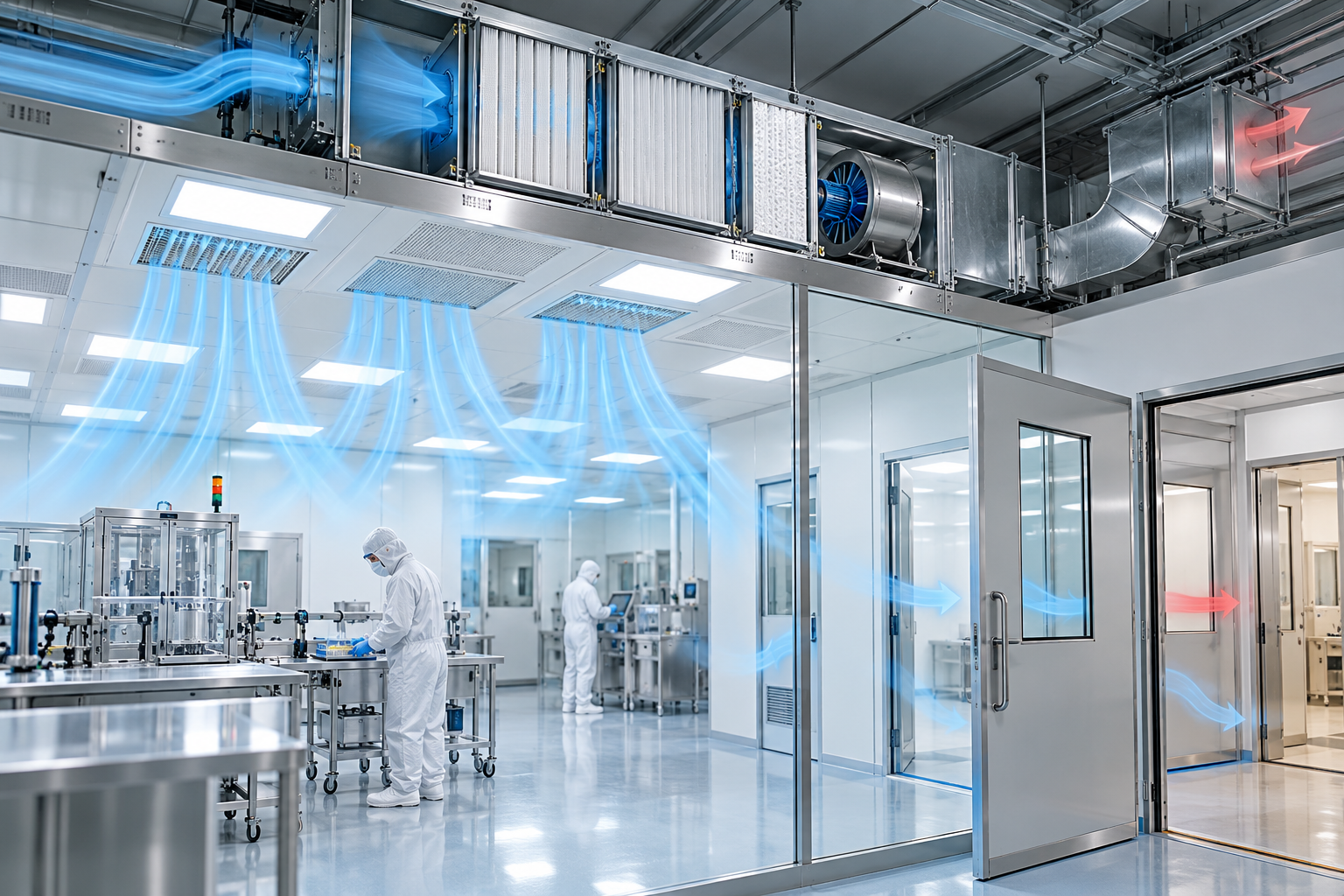
Pressure differentials keep air flowing from cleaner areas to less clean ones. In a pharmaceutical or electronics facility, a cascade such as a Grade B room kept above a Grade C corridor stops contaminants moving the wrong way when a door opens.
When the differential drifts, three things follow:
- Airflow can reverse and carry particles into the cleaner room.
- Batch records and audits show out-of-limit readings, which raises compliance risk.
- Alarms trigger, production stops and investigations begin.
Common reasons pressure differentials drift
1. Filter loading
As HEPA and pre-filters collect dust, their resistance rises and airflow falls. A supply side that has slowed down relative to the extract side lowers room pressure. Monitor the pressure drop across each filter stage and replace filters on measured data, not only on a calendar.
2. Damper and VAV/CAV drift
Dampers and actuators lose calibration, and linkages loosen. A damper that no longer sits where the BMS thinks it does will quietly change the balance of supply, return and exhaust air.
3. Fan speed and VFD changes
Belt wear, motor issues or changed VFD settings alter airflow. Even small changes in fan speed shift pressures across the whole cascade.
4. Leakage through the room envelope
Gaps in ceiling panels, wall junctions, service penetrations, pass boxes and door frames leak air. Leakage grows with age and after maintenance work. Well-designed cleanroom construction with sealed panel joints limits this.
5. Doors and gaskets
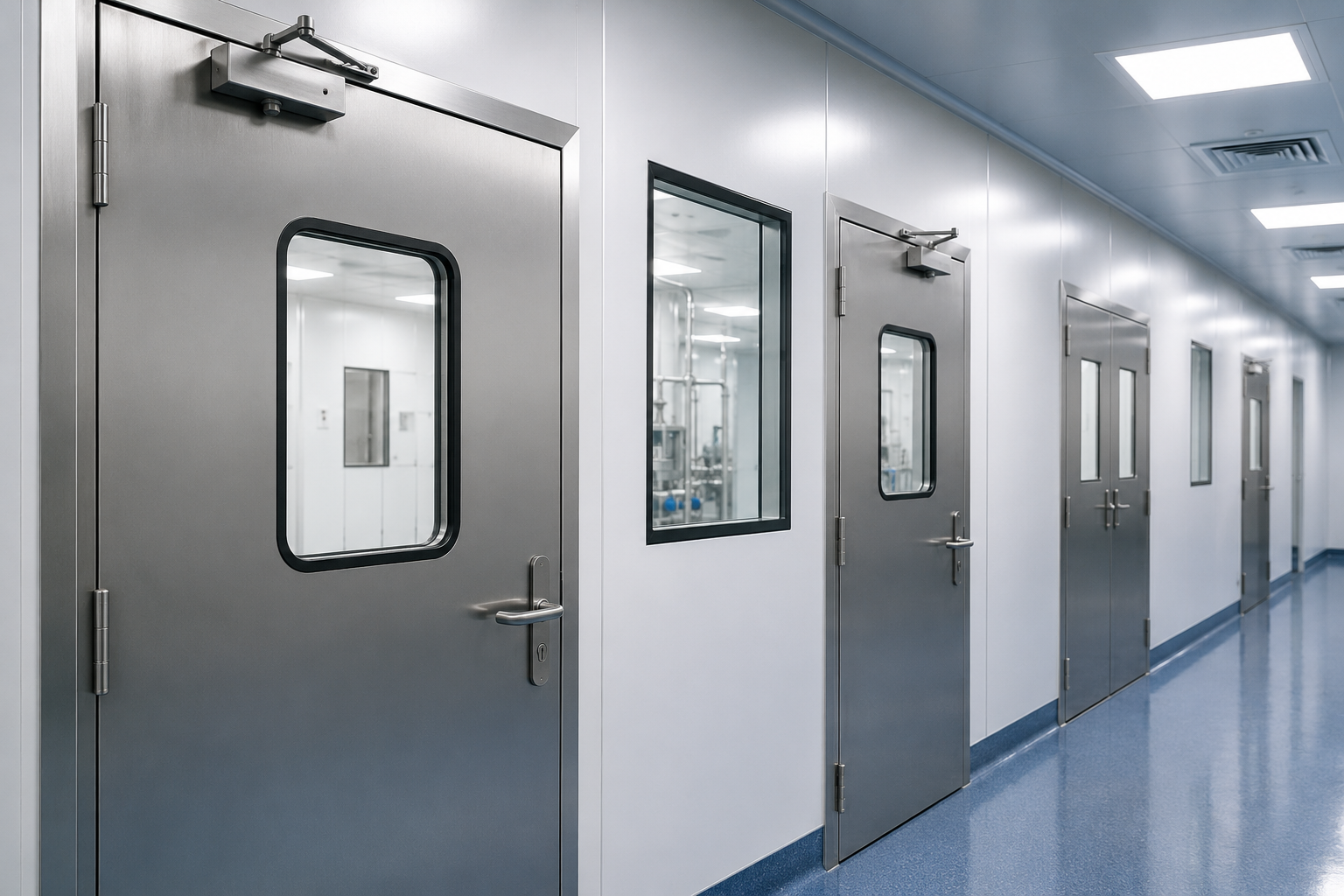
Worn gaskets, wrong door gaps, doors left open and interlock faults change the pressure behaviour of a room quickly. Our guide to metal door selection for GMP facilities covers gaps, gaskets and interlocks in detail.
6. Blocked or modified return and exhaust paths
Blocked return grilles, closed exhaust dampers or extra equipment that adds exhaust load change the air balance, often without anyone noticing.
7. Sensor and gauge errors
Sometimes the room is fine and the instrument is wrong. Differential pressure transmitters drift, tubing gets blocked or kinked, and zero points shift. Calibrate before you rebalance.
8. Control loop and BMS tuning
Poorly tuned PID loops hunt around the setpoint and create unstable readings. A well-configured BMS with sensible alarm delays reduces nuisance alarms from door openings.
Why particle counts drift
Particle counts depend on how much air reaches the room, how clean that air is and how many particles the room generates.
- HEPA filter leaks: Pinholes, damaged media or poorly seated gaskets let particles through. A HEPA integrity test with aerosol photometer scanning finds them.
- Lower air change rates: Airflow lost to filter loading or fan changes reduces how fast particles are diluted and removed.
- Poor air distribution: Blocked diffusers, moved equipment and cluttered layouts disturb unidirectional flow and create dead zones.
- Ingress from adjacent areas: A pressure cascade that has drifted lets particles move in from lower-grade areas.
- Personnel and material movement: Gowning errors, fast movement and cardboard or shedding materials increase counts quickly.
- Surface and cleaning issues: Poor cleaning technique, wrong disinfectants or damaged surfaces add particles.
- Temperature and humidity swings: Very low humidity increases static and particle shedding. Condensation causes other problems.
- Particle counter and sampling errors: Long sample tubing, wrong probe position, uncalibrated counters and incorrect sampling volume produce misleading numbers.
For reference, ISO 14644-1 sets maximum concentrations of particles of 0.5 µm and larger per cubic metre. These are about 3,520 for ISO 5, 352,000 for ISO 7 and 3,520,000 for ISO 8.
Step-by-step cleanroom HVAC troubleshooting method
- Confirm the reading. Check the calibration of the pressure gauge or particle counter and its sampling setup.
- Check what changed. Look for recent maintenance, shutdowns, new equipment, door changes or process changes.
- Review the trend. Sudden drift points to a failure (damper, door, fan). Gradual drift points to filter loading or wear.
- Inspect the filters. Read pressure drop across pre-filters, fine filters and HEPA filters against design values.
- Measure airflow. Verify supply, return and exhaust volumes and air change rates against the design.
- Check the envelope. Inspect doors, gaskets, pass boxes, panel joints and penetrations for leaks.
- Test the HEPA filters. Run integrity tests if particle counts are high or the airflow pattern is suspect.
- Rebalance and retune. Adjust dampers and VFD settings, then tune control loops.
- Re-test and document. Repeat the pressure and particle tests, check recovery time and record the findings.
Quick reference: symptom, likely cause, first check
| Symptom | Likely cause | First check |
|---|---|---|
| Pressure slowly falls over weeks | Filter loading | Filter pressure drop |
| Sudden pressure loss | Damper, fan or door fault | Fan status, damper position, door closure |
| Pressure unstable or hunting | Control loop tuning | BMS PID settings |
| High counts after maintenance | Disturbed filters or ingress | HEPA integrity test, gasket seating |
| High counts in one spot | Local leak or blocked diffuser | Filter scan, airflow pattern |
| Counts fine, pressure alarms | Sensor drift | Transmitter calibration |
Preventing drift
- Schedule regular validation. Testing and validation of airflow, pressure, HEPA integrity, particle counts and recovery time catches problems early.
- Maintain the HVAC system. Service AHUs, replace filters on measured data and calibrate instruments.
- Keep doors and gaskets in good condition. Inspect them routinely and train staff on door discipline.
- Use continuous monitoring. Trend pressure, temperature, humidity and particle counts so slow drift is seen before it becomes a deviation.
- Control the design at the start. A cleanroom designed, built and validated by one team, as in a turnkey cleanroom project, avoids many of the interface problems that cause drift later.
When to call a specialist
Bring in cleanroom engineers when readings stay out of limits after you have checked filters, doors and sensors, when drift keeps recurring, or when you are preparing for an audit or revalidation. A proper airflow and leakage investigation usually costs far less than repeated batch deviations.
FAQs
What causes pressure differential drift in a cleanroom?
The most common causes are loaded filters, damper or fan-speed drift, door and gasket problems, envelope leakage and uncalibrated sensors.
What is a typical pressure differential between cleanroom zones?
Adjacent classified areas are usually kept 10-15 Pa apart. Your design, GMP guidelines and process requirements set the exact values.
Why are particle counts high even with HEPA filters installed?
HEPA filters can leak, airflow can be too low, or contamination may be entering through door openings, people or materials. Counter and sampling errors can also give false readings.
How often should cleanroom HVAC be validated?
Requalification is usually done at set intervals defined by your quality system and the cleanroom classification, and again after major maintenance or modification.
Can one fix cure both pressure and particle problems?
Often, yes. Restoring correct airflow and sealing leaks tends to improve both, because the two problems share root causes.
Need help with a drifting cleanroom?
S.M. Enterprises designs, builds, tests and maintains cleanrooms, HVAC systems, modular OTs and GMP facilities from Bengaluru. Talk to our engineers through the contact page or call 8296497411 / 8904450199.
Need this for your facility?
Get a detailed quote from our engineering team — typically within 24 hours.